Listing usually nets more, unless your house needs major work. What it costs to sell a distressed house in Oregon, how long it takes, and when an extra $10,000 isn’t worth 120 days.
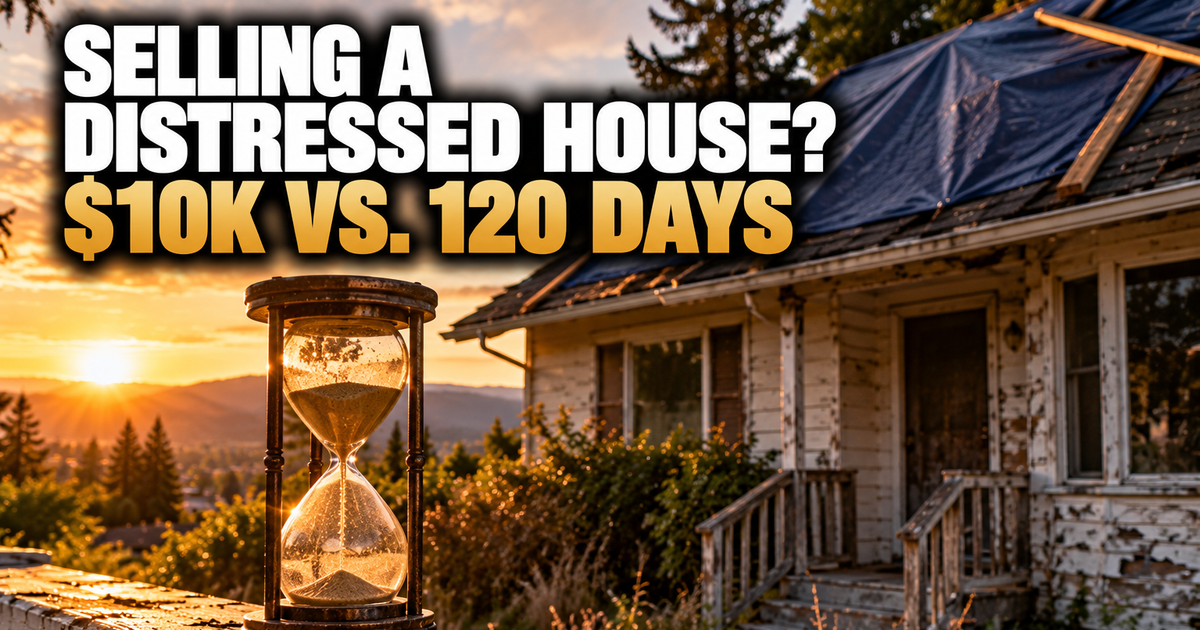
Short answer: if your house is in decent shape and you have time, listing with a good agent will usually net you more than a cash buyer. A distressed house changes that math. When a house needs major repairs, buyers’ lenders, appraisals and inspections get in the way, the listing takes longer, and every month it sits costs you money. Sometimes the extra $10,000 you’d get by listing is gone by the time it closes.
A distressed property is a house that’s hard to sell the normal way, either because of its condition or the owner’s situation:
Many houses are both. This post is mostly about the first kind: how to sell a house that needs repairs, and whether to fix it, list it as-is, or sell it for cash.
Yes. You can sell a house as-is in Oregon without fixing anything. As-is means you won’t make repairs. It doesn’t mean you can hide problems: if you’re required to fill out Oregon’s seller property disclosure statement (ORS 105.464), you still disclose what you know. If you sell your house as-is for cash, there are usually no repair requests at all, because the buyer has already priced the work in.
Most of the time, a house that’s in decent shape will net more on the open market. A good agent gets you in front of more buyers, and more buyers usually means a higher price. That’s true even at 7% mortgage rates.
A distressed house is different, for three reasons:
With an agent, figure about 5.5% in commission plus around $2,500 in closing costs, before prep, repair credits and holding costs. Here’s what typically comes out of a listing in Oregon:
A cash sale skips the commission, the prep and the repair credits. The trade-off is a lower price, because the buyer is taking on the repairs, the holding costs and the risk. Investors work backward from what the house will be worth fixed up, then subtract repairs, holding, resale costs and their profit. For a full line-by-line comparison, read cash offer vs. listing.
In September 2026, homes averaged 53 days on market in Lane County, 68 days in the Portland metro and 71 days in Polk and Marion counties. Those are averages for all houses. A house that needs work, priced off what it would be worth fixed up, usually sits longer. After you accept an offer, a financed sale usually takes another 30 to 45 days to close, and longer if the lender requires repairs first. Mortgage rates above 7% are a big part of why; read why isn’t my house selling in Oregon.
A cash sale can close in as little as seven days, or on whatever date you choose. My one Roseburg deal was a mobile home on its own land that was too old for any lender to finance. The seller had an agent, but only a cash buyer could actually close it. We closed in five to seven days. More on that in selling a mobile home on land in Oregon.
Here’s an example for a house that needs work. These are example numbers, not an offer. Say the best as-is listing price you can expect is $300,000, and a cash buyer offers $265,000.
Listing it as-is:
Selling for cash:
On paper, listing looked $13,500 better. After five months of holding costs, the gap is about $2,250, and that’s if the deal doesn’t fall through, the price doesn’t get cut, and the repair credits don’t grow. If you need to get out now, or that $2,500 a month is hard to carry, the extra money may not be worth the wait. Your numbers will be different, so get both before you decide.
Spring. Zillow’s 2026 analysis found that homes in the Portland metro listed in the last two weeks of May sold for 2.2% more, about $12,400 on a typical Portland home. Nationally, Realtor.com picked April 12 to 18 as the best week to list in 2026: homes listed that week were priced about 1.3% higher than an average week, and in 2025 they spent 50 days on market, 10 days fewer than average.
The catch is the calendar. If it’s November and you wait to list in late May, that’s six months of holding costs before the house even hits the market, then time on market and closing. On a $300,000 house, a 2.2% spring premium is about $6,600. Eight months of holding at $2,500 a month is about $20,000. Fall and winter are slower in Oregon, but for a distressed house, waiting for spring only pays if you can carry it comfortably and the house will show well by then.
Whatever you pick, get a real listing price from an agent and a real cash offer, and compare what you’d walk away with, not just the sale price.
We buy distressed houses as-is in Eugene, Springfield, Roseburg, Salem, Medford, Grants Pass and across Oregon, including houses with fire damage, water damage, old roofs, liens or tenants. You don’t clean it out or fix anything, and you pick the closing date. I’m a real estate investor and cash home buyer, and I’m also a registered Oregon residential property wholesaler, #201264508. If you want to know what selling to us looks like step by step, read what to expect when selling to a cash home buyer in Oregon. Call and ask for Gerren at (541) 250-3067.
Can you sell a house as-is in Oregon? Yes. You don’t have to make repairs, but if you’re required to fill out Oregon’s seller disclosure statement, you still disclose what you know.
Is it better to sell to a cash buyer or a realtor? If the house is in good shape and you can wait, a realtor usually nets more. If it needs major repairs, can’t be financed as-is, or you need to close fast, a cash buyer is often the better route once you count holding costs and deals that fall through.
How much do cash buyers pay for distressed houses? Cash buyers start from what the house would be worth fixed up and subtract repairs, holding costs, resale costs and profit. The more work the house needs, the bigger the discount. Get a written offer and compare it to what you’d net from a listing.
How long does it take to sell a house that needs repairs? On the market, often longer than the 53 to 71 day averages in Oregon right now, plus 30 to 45 days to close with a financed buyer. A cash sale can close in as little as seven days.
What is the best time to sell a house in Oregon? Late spring. Zillow found Portland-area homes listed in the last two weeks of May sold for 2.2% more. Fall and winter are slower.
Is now a good time to sell a house in Oregon? For a house in good shape, spring usually brings more buyers and a better price. With mortgage rates above 7% and more listings than a year ago, fall and winter are slower. If the house needs major work or you need to sell soon, waiting often costs more in holding costs than it gains.
How much does it cost to sell a house in Oregon? With an agent, figure about 5.5% in commission plus around $2,500 in seller closing costs, before any prep, repair credits or holding costs.
Will an FHA buyer be able to buy my distressed house? Only if it meets FHA’s minimum property standards or the required repairs get done before closing. A house with a failing roof, peeling paint, or heating, electrical or plumbing that doesn’t work usually won’t pass as-is.
Example numbers are illustrations, not offers or appraisals. General information, not financial or legal advice.
