We found 24 leased solar panels two weeks into a Hillsboro deal. Prepayment vs. buyout, the payoff quote that was $31,000 off, and how the transfer really works.
Two weeks into a deal on a 1970s house in Hillsboro, we found out the roof had 24 solar panels on a 25-year power purchase agreement with GoodLeap. It wasn’t on the title report, and nobody had mentioned it. By the time we sorted it out, the first buyer had walked, the price had come down, and I’d learned more about solar contracts than I ever planned to.
Can you sell a house with solar panels on it? Yes, even when the panels are leased. But if you’re selling a house with leased solar panels in Oregon, or buying one, here’s what I wish I’d known on day one.
There are three ways a house ends up with solar panels:
Our house had a PPA. The homeowner paid for the electricity the panels produced at $0.19 per kilowatt-hour in year one, going up 2.99% every year for 25 years. That worked out to about $157 a month.
Under a lease or PPA, the solar company keeps the tax credits, rebates and renewable energy credits. The homeowner gets none of them. The federal residential solar tax credit ended December 31, 2025, and it only ever applied to systems the homeowner owned.
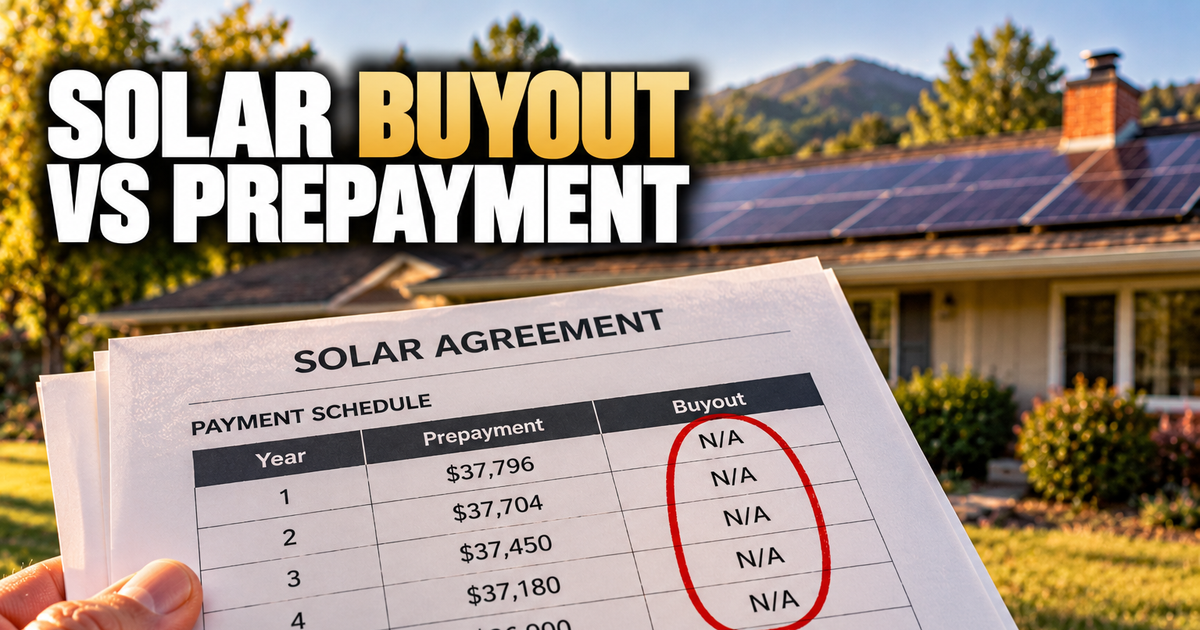
This is the part that cost us weeks. Most solar contracts have a payment schedule near the back with more than one number for each year. On ours it was Exhibit 9.
We spent weeks fighting over the prepayment number, thinking it would clear the solar off the house. It wouldn’t have. The contract said it plainly: prepaying doesn’t end the agreement. The company still owns the panels, still has access to the roof, and the next owner still signs a transfer agreement. Prepaying buys silence on the payment, not ownership.
If a buyer or a lender wants the solar gone, you need the buyout column, not the prepayment column. And check which years it’s even available.
When we asked for the prepayment amount, the official quote came back at $68,749.08. The schedule in the signed contract said $37,703.52 for that year. That’s about $31,000 apart.
As far as we could tell, the quote added up every remaining monthly payment, with the yearly increase, and skipped the discount the contract’s own schedule applies. We never got it corrected before closing. What I’d do differently:
That’s what I thought at first. The house used to pay Portland General Electric about $180 a month. With the solar, the PGE bill dropped to about $20, but the homeowner paid the solar company about $157 a month. That’s $177 versus $180. Basically even. So what’s the point?
Then I started looking at it like a 401(k). The point isn’t month one. It’s year ten.
The solar payment goes up 2.99% a year, no matter what. PGE goes up whatever regulators approve, and PGE’s residential rates have climbed nearly 60% since 2020. The leftover $20 PGE bill still rises with PGE, but 5% of $20 is a dollar. Starting from $180 without solar and $177 with it, here’s roughly how the monthly gap grows:
So it depends on what the utility does. PGE is asking for 3.9% for 2027, and over the last six years it averaged a lot more than that. Nobody knows the next ten.
Once the buyout opens up in year six, the math changes again. Pay the buyout and the solar payment is gone for good. You’re left with a small PGE bill and panels you own.
That’s the story a buyer needs to hear. I didn’t get it at first either, and a buyer who doesn’t get it will walk. Pull the seller’s last 12 months of utility bills before they move out. It’s the most convincing document you’ll have.
If it feels like you can’t sell your house because of the solar panels, you can. It just takes these steps, and every contract is different, so read yours. Ours worked like this:
On our deal, the transfer paperwork didn’t show up until after closing. Because the PPA never appeared on the title report, title didn’t hold up the sale, so the house closed and we’re finishing the transfer now, including the $250 fee. That worked, but it isn’t ideal: until the solar company releases the seller in writing, he’s still on the hook for the contract. Next time I’ll request the transfer paperwork the day we go under contract, as its own written demand with its own deadline, separate from any payoff conversation.
One thing that helped: our PPA was not a lien. It never showed up on the title report, and there was no fixture filing. Some solar contracts do record a filing with the county, so have your title company check. If there isn’t one, tell agents and lenders plainly. A lot of them assume there is.
Our system was installed by Freedom Forever, one of the biggest residential solar installers in the country. It filed for Chapter 11 on April 15, 2026, and the case was converted to a Chapter 7 liquidation on August 7, 2026.
That sounds scary to a buyer. But on our contract, the system warranty and the 10-year roof warranty sat with GoodLeap, not the installer, so the bankruptcy didn’t wipe them out. Check the warranty section of your contract to see who actually stands behind yours. If it’s the finance company, say so in your listing.
We buy houses with leased, PPA and financed solar across Oregon, as-is, and now we know how to work these contracts. If you’re in the west metro, here’s our page for cash home buyers in Hillsboro. I’m a real estate investor and cash home buyer, and I’m also a registered Oregon residential property wholesaler, #201264508. Before you sign with any buyer, including us, here’s how to check whether cash home buyers in Oregon are legitimate. Call and ask for Gerren at (541) 250-3067.
Can I sell my house with solar panels on it? Yes. If you own the panels outright, they go with the house. If you have a solar loan, it gets paid off at closing. If the panels are leased or on a PPA, the buyer takes over the contract or someone pays it off. Give the solar company written notice early.
How do I transfer a solar lease when I sell my house? Give the solar company written notice early (ours required 30 days to three months before the sale), have the buyer pass the credit check or pay the waiver fee, sign the transfer agreement, and get a written release for the seller. Start the solar lease transfer the day you go under contract, not after closing.
Can I sell my house with a solar loan? Yes. You own the panels, so they convey with the house, and the solar loan is paid off out of your sale proceeds like a mortgage. Get a payoff statement early, and check whether the lender recorded a fixture filing that title will need released. More in how to sell your house with a solar loan.
Should I buy a house with leased solar panels? It can work, but get the full contract first. Look at the monthly payment, the yearly increase, the buyout column and who holds the warranty, and ask for the seller’s last 12 months of utility bills so you can see what you’re really taking on.
What’s the difference between a solar prepayment and a buyout? A prepayment ends the monthly payments, but the solar company still owns the panels. A buyout transfers ownership of the system to you. On many contracts the buyout isn’t available for the first several years.
Do leased solar panels show up on a title report? Not always. Ours didn’t. Some companies record a fixture filing with the county and some don’t. Ask the seller directly and have the title company check.
What happens if the buyer doesn’t qualify to take over the solar? On our contract, someone could pay a $250 waiver fee instead. Otherwise the seller may have to prepay or buy out the contract. Check yours.
Is leased solar worth it in Oregon? It depends on how fast PGE or Pacific Power rates rise. If they rise about 3% a year, it’s roughly a wash against a 2.99% escalator. If they rise faster, the savings grow every year.
How fast can I sell a house with solar for cash? Plan around the transfer notice, which on our contract had to go in at least 30 days before closing. Send it the day you sign, and a cash sale can close right after that window.
General information, not legal or financial advice. Every solar contract is different. Read yours, and talk to a real estate attorney about your situation.
