Oregon now requires Wholesalers to register, pass an FBI background check, and disclose before you sign. Here's what that means for you.
Oregon's House Bill 4058 took effect July 1, 2025. It requires most real estate wholesalers to register with the state, pass a background check, and give you a written disclosure before you sign anything. If a wholesaler doesn't give you that disclosure, you can cancel the contract at any time, without penalty, and keep the earnest money. Even when they do everything right, you still get three business days to walk away. This page explains the law in plain English and shows you how to check, in about ninety seconds, whether the person offering to buy your house is actually registered.
House Bill 4058 is the Oregon law that regulates residential property wholesaling. The Legislature passed it in the 2024 session, it was codified at Oregon Laws 2024, Chapter 3, and it applies to every contract entered into on or after July 1, 2025.
Before HB 4058, anyone in Oregon could put a house under contract and assign their rights under that contract to someone else without a license, without registering, and without telling the homeowner they were doing it. There was no state oversight and no consequence for staying quiet about it. Oregon is now among a growing number of states regulating this directly, and the law is written to protect the person selling the house.
If you've gotten a letter, a postcard, or a cold call offering to buy your house for cash, this law is about that transaction.
Wholesaling is when someone signs a purchase agreement to buy your house and then assigns their rights under that contract to another buyer — usually called an end buyer — who closes in their place.
The wholesaler never takes ownership of your house. What they hold is an equitable interest: a contractual right to buy the property on the terms the two of you already agreed to. Assigning that right is what they're actually paid for, and the payment is called an assignment fee.
Here's what that looks like from your kitchen table. You agree to sell for $250,000 and sign a purchase agreement with the wholesaler as the buyer. Rather than closing with their own money, they find an investor willing to step into that agreement and pay a $15,000 assignment fee for the right to do it. The investor becomes the buyer of record, closes on the terms already written in your contract, and you receive the $250,000 you agreed to. Title transfers once — from you directly to the end buyer. The wholesaler never owned your house at any point.
An assignment does not, by itself, change your price or your terms. It moves the buyer's side of the agreement to someone else; it doesn't reopen what you signed. What it does change is who actually shows up with the money at closing — which is why Oregon decided you're entitled to know it's happening before you sign. It's also why the red flags further down matter: a wholesaler who can't find an end buyer at your price may come back and ask you to renegotiate, and you are under no obligation to agree.
That practice isn't illegal, and it isn't automatically bad for you — a wholesaler with a strong buyer list can sometimes move faster than anyone else. The problem HB 4058 was written to solve is that many sellers never knew it was happening. They thought they were selling to the person in front of them.
Oregon's legal definition is narrower than the everyday one. Under the statute, you're a residential property wholesaler when you market residential property in which you hold only an equitable interest or an option to purchase, you've held that interest for fewer than 90 days, and you've put less than $10,000 into development or improvement costs. All three conditions have to be true.
That definition matters, because it means a company that actually closes on houses with its own funds and holds them isn't wholesaling under this law — and a company that assigns contracts within 90 days is, whether they use the word or not.
Set the legal machinery aside for a second. Here's what HB 4058 changes about your actual situation.
You are allowed to ask, and you're entitled to a straight answer. "Are you buying this yourself, or are you assigning the contract to someone else?" That question used to get a shrug. Now the law requires the answer in writing, in bold type, before you sign.
You have time you didn't have before. Three business days, minimum, no reason required, cannot be waived. Anyone who tells you the offer disappears if you don't sign tonight is telling you something about themselves, not about the offer.
You can check someone out before you let them in. A free state database tells you in under two minutes whether the person offering to buy your house has been fingerprinted, background-checked, and cleared by the State of Oregon to do this work. Most Oregon homeowners don't know it's there.
If someone skipped the disclosure, you have real leverage. Not a complaint form. A statutory right to walk away and keep the earnest money.
And you have a filter for the cold calls. If you own a house in Oregon — especially if you're behind on payments, went through probate, or have a code violation on file — you're on lists. The postcards and calls are going to keep coming. Registration is the fastest way to sort the people worth talking to from the people who found your name on a spreadsheet.
None of this means you should be afraid of cash buyers. Selling to one is often the right call, and for some situations it's the only call that works. It means you get to be the one holding the information for once.
Anyone wholesaling residential property in Oregon has to register with the Oregon Real Estate Agency unless they're exempt. A single transaction is enough to trigger the requirement — there's no "just doing one deal" exception.
People hear "registered" and picture filling out a form online. It isn't that. Here is the actual gauntlet a person has to walk through before Oregon will let them do this work:
They have to be a real, findable business. Every entity, business name, and assumed business name a person uses to wholesale has to be registered with the Corporations Division of the Oregon Secretary of State. You cannot legally do this under a name that isn't on file somewhere public. No operating as a company that doesn't exist on paper.
Worth understanding how these two pieces fit together, because it's the part people get wrong. The wholesaler registration is issued to a person — a human being with fingerprints on file. The business is registered separately, with the Secretary of State. You need both. A company cannot hold a wholesaler registration, and a registered person cannot operate under a business name they never filed. Which means there are two separate public records behind anyone doing this legally in Oregon, and you can check both.
They have to be fingerprinted in person. Not uploaded, not self-reported. You go to a Fieldprint location and get printed.
Those fingerprints go to the Oregon State Police and the FBI. A full criminal background check runs against both. It takes two to three weeks to come back, and nothing moves until it does.
They have to disclose everything, in writing, up front. Every felony. Every misdemeanor. Every unadjudicated arrest. Every DUI and major traffic offense. Every administrative proceeding. Every adverse or unsatisfied judgment and bankruptcy. And here's the part with teeth: failure to disclose any of it is itself grounds for denial. Leaving something out is worse than the thing you left out.
The state makes a fitness determination. Under ORS 181A.195, the Agency doesn't just look at whether a record exists — it weighs the nature of the offense, how relevant it is to the work, how much time has passed, the person's age at the time, and the likelihood of repetition, then decides whether the applicant is fit to hold the registration. An application can be denied on that basis.
They have to pay to get in, and pay to stay in. $300 to apply, plus the Fieldprint fee. Then $300 every single year — registrations expire annually on June 30. Miss the deadline and you can't simply renew: you have to file a complete new application and pay the fees again. And each 30-day period a person keeps wholesaling on a lapsed registration counts as a separate offense.
They stay accountable after they're in. The Real Estate Commissioner can discipline a registered wholesaler for material misrepresentation, fraud, bad faith, incompetence, or dishonest dealing — up to suspending or revoking the registration outright. Registration isn't a certificate you hang on the wall. It's a leash the state keeps holding.
Now think about what that means from where you're sitting. Somebody sent you a postcard offering cash for your house. If that person is registered, the State of Oregon has their fingerprints, has run them through the FBI, has made an affirmative determination that they're fit to hold the registration, required them to disclose their judgments and bankruptcies under penalty of denial, and can take their livelihood away if they mistreat you.
If they're not registered, none of that has happened. Nobody has checked anything. Nobody is holding anything.
That's the whole difference, and it's a big one.
This is the heart of the law. A wholesaler must give written disclosure to every "covered party" — that includes you as the seller, potential buyers, and any real estate broker involved — before entering into a contract. The disclosure also has to appear in the property's advertising. (Social media posts are exempt only if they link to a separate page carrying the full disclosure.)
The statute requires the disclosure to be in at least 10-point bold type and to tell you, at minimum:
Read that list again, because it's a remarkably honest set of admissions to force someone to hand you in bold type before you sign.
The state's rules require the form to tell you more than that. It also has to spell out your three-business-day cancellation right, define what an equitable interest is in plain language, state outright that a wholesaler may assign that equitable interest to another party before closing for a profit, and tell you how to file a complaint with the Oregon Real Estate Agency. That last one is unusual and worth noticing: the state requires the person buying your house to hand you the instructions for reporting them.
One more thing to know. There is an official form published on the Agency's website — one version for registered wholesalers, a separate one for licensed brokers and principal brokers who wholesale. It isn't a template someone can rewrite. If the "disclosure" you're handed is something the buyer drafted themselves, that is itself a problem.
HB 4058 gives you two separate escape hatches. They work differently, and it's worth knowing both.
Once you receive the disclosure, you can cancel the contract without penalty by delivering written notice of cancellation any time before midnight at the end of the third business day after you got it. You don't need a reason. Your deposits come back.
This right cannot be waived. If someone puts a clause in front of you asking you to sign away your three-day cancellation right, that clause is unenforceable — and you should treat the request itself as a serious warning sign.
This is the provision most Oregon homeowners have never heard, and it's the strongest protection in the law.
If a wholesaler fails to give you the required disclosure, you may terminate the contract at any time, without penalty — and keep any earnest money that was paid. Not three days. Any time.
The statute goes further. The wholesaler can be held liable for damages incurred by the seller and the buyer. And if it goes to a dispute, the prevailing party recovers reasonable attorney fees, costs, and expenses — at trial, on appeal, at mediation, and at arbitration — from the wholesaler.
On the earnest money held in escrow, know how this actually works before you count on it. An escrow agent may disburse the deposits to you, but you have to give them two things: a written assertion that no disclosure was provided along with a demand for the funds, and a written release and indemnification protecting the escrow agent from liability for paying out. That second document is the part people don't expect, and some escrow agents will not move without it. Ask a real estate attorney to prepare both.
So if you're under contract with a cash buyer right now and you never received a bold-type written disclosure telling you they're a wholesaler holding only an equitable interest, Oregon law may let you walk away and keep the deposit. That's worth a conversation with a real estate attorney.
The penalties are real, and they're worth knowing because they tell you how seriously the state takes this.
A knowing violation is a Class A misdemeanor. This is criminal, not just regulatory.
Operating unregistered carries a civil penalty of $1,000 to $2,500 for a first offense, and $2,500 to $5,000 for subsequent offenses.
On top of that, the state can take the profit. Any unregistered transaction carries an additional penalty of up to the full amount made on the deal.
A lapsed registration compounds. Each 30-day period during which someone keeps wholesaling on a lapsed registration counts as a separate offense.
Misrepresentation, fraud, bad faith, incompetence, or dishonest dealing can be disciplined by the Real Estate Commissioner — up to suspension or revocation of the registration entirely.
There's one more consequence that quietly matters more than the fines: an unregistered wholesaler cannot bring a lawsuit to enforce any claim arising from their wholesaling activity. They lose access to the courts on that deal. If an unregistered wholesaler tries to force you to perform on a contract, that's a wall they run into.
The Commissioner can also issue cease-and-desist orders against unregistered wholesalers, effective 30 days after the order unless the person named requests a hearing. The Commissioner can investigate on a complaint or on the Agency's own motion, and can go to court to enjoin someone from continuing to violate the law.
Not everyone doing this work has to register. The statute exempts:
If someone tells you they're exempt, the honest ones can tell you exactly which category they fall in. "I don't need to register" is not an answer. "I'm a licensed principal broker, here's my license number and here's the broker disclosure form" is. And notice how specific these categories are — a stranger who cold-called you about your house almost certainly doesn't fit any of them.
If you're weighing cash offers, this is the practical case for filtering on registration before you look at anything else — including price.
Someone independent has already vetted them. You are not in a position to run a background check on a stranger who wants to buy your house. The state already did. Registration means fingerprints, an FBI and Oregon State Police records check, mandatory disclosure of judgments and bankruptcies, and a state determination that the person is fit to hold the registration. You get the benefit of that work for free, by typing a name into a search box.
They have something to lose. An unregistered operator risks a fine if they're caught. A registered wholesaler risks their registration, which is their ability to earn a living in this business at all. That asymmetry changes how someone behaves when a deal gets complicated — and deals get complicated.
You get the disclosure the law was written to give you. Registered wholesalers use the state's standardized form. You'll know before you sign whether the person is closing with their own money or assigning your contract to someone else. That single fact changes what your closing actually depends on, and you're entitled to it.
They can be held to the contract — and so can you. Here's a consequence most people miss: an unregistered wholesaler cannot bring a lawsuit to enforce any claim arising from their wholesaling activity. That sounds like it helps you, and sometimes it does. But it also means you're in a contract with someone who has no legal standing to be there, on the largest asset you own, with a closing date you may be depending on. That's not protection. That's a deal built on sand.
There's a paper trail if something goes wrong. A registered wholesaler is in a state database with a real business entity behind them, and the Real Estate Commissioner takes complaints. An unregistered one is a phone number that can stop working.
And your remedies are actually collectable. The three-day cancellation right, the disclosure requirement, and the earnest-money remedy apply to anyone wholesaling in Oregon, registered or not — the law doesn't let someone escape it by ignoring it. But a right is only worth what you can enforce. Filing a complaint against a registrant with a livelihood on the line is a very different afternoon than chasing someone who was never in the system and has already moved on.
Here's the honest summary of what you're choosing between.
A registered Oregon wholesaler has been fingerprinted and run through both the FBI and the Oregon State Police. An unregistered operator has not been checked by anyone.
A registered wholesaler had to disclose their judgments and bankruptcies, and had the state determine they're fit to hold the registration. An unregistered operator answered to no one.
A registered wholesaler must hand you a written disclosure in 10-point bold type before you sign. An unregistered operator is already ignoring the law that requires it — which tells you what to expect from the rest of the transaction.
A registered wholesaler has their registration and their livelihood on the line if they mistreat you, and can be disciplined, suspended, or shut down by the Real Estate Commissioner. An unregistered operator risks a fine if somebody catches them.
A registered wholesaler shows up in two public records — the individual in the state's wholesaler database, and their company in the Secretary of State's business registry. An unregistered operator appears in neither, and you can confirm that yourself in about two minutes.
And a registered wholesaler can legally enforce a contract — an unregistered one cannot. That sounds like it works in your favor, and sometimes it does. But it also means you'd be under contract on the largest asset you own with someone who has no legal standing to be there, on a closing date you may be counting on. That's not protection. That's a deal built on sand.
None of this means a registered wholesaler will automatically give you the best number. Compare offers, ask hard questions, and take your three days. It means that when you're deciding who to let into your house and onto your paperwork, registration is the one filter you can verify yourself, for free, before you spend energy on anything else.
This takes about ninety seconds, it's free, and almost no Oregon homeowner knows they can do it.
orea.elicense.micropact.com/Lookup/LicenseLookup.aspxA few things to watch for while you're there.
Search the person, not the company. Oregon issues this registration only to individuals. A company can wholesale, but only through a registered person doing the work. So if you're handed a business card for an LLC, ask who the registered individual is and look up that name. (The dropdown does have a separate "Registered Business Name" type, but that's a different filing — it won't confirm anyone's wholesaler registration.)
Check the name against the paperwork. If a person introduces themselves one way and the contract says something else, ask why.
An expired record is meaningful, not a technicality. Registrations expire every June 30, and someone who let theirs lapse can't just renew — they have to apply all over again.
If they claim a broker exemption instead, search License Type Broker, Principal Broker, or Property Manager and verify that way.
Almost nobody does this second step, and it takes another minute.
Go to the Oregon Secretary of State's business registry search at sos.oregon.gov and look up the company name on your paperwork. You're checking three things: that the business actually exists, that its status is active rather than inactive or dissolved, and that the registered agent and principal names line up with the person you've been talking to.
A registered wholesaler working through a company should pass both checks — the individual in the OREA lookup, the company in the Secretary of State registry. If the person checks out but the company doesn't exist, or the company exists but nobody connected to it is registered as a wholesaler, you've found something worth asking about before you sign anything.
If you can't find them at all, and they can't name an exemption that applies, you are dealing with someone operating outside Oregon law.
Any one of these is worth slowing down over:
We'll be straightforward, because that's the entire point of this article.
Gerren Castle is a registered Oregon residential property wholesaler, OREA registration number {{OREA_REG_NUMBER}}. G&C Property Solutions LLC is registered with the Oregon Secretary of State, and wholesales through him.
That's exactly how Oregon requires it to work, and it's worth saying plainly: the state issues this registration only to individual people, never to companies — and every business name used to wholesale has to be filed with the Secretary of State. So any business doing this legally in Oregon has both a real registered company and a real named human being standing behind it. You can check both records yourself in about two minutes. If a company can't tell you who their registered individual is, that's your answer.
He went through the fingerprinting. He went through the FBI and Oregon State Police background check. He disclosed his history, and the state made its determination. The registration fee gets paid every year to keep it current.
We're publishing that number here on purpose. Take it to the Oregon Real Estate Agency's lookup, select Wholesaler, and check before you ever pick up the phone. We'd rather you verify us than trust us.
We give every seller the state's written disclosure before anything gets signed, in the bold type the law requires. We tell you plainly whether we're closing with our own funds or assigning the contract, because you deserve to know which one is happening with your house. We honor the three-day cancellation right without argument, and we don't ask anyone to waive it.
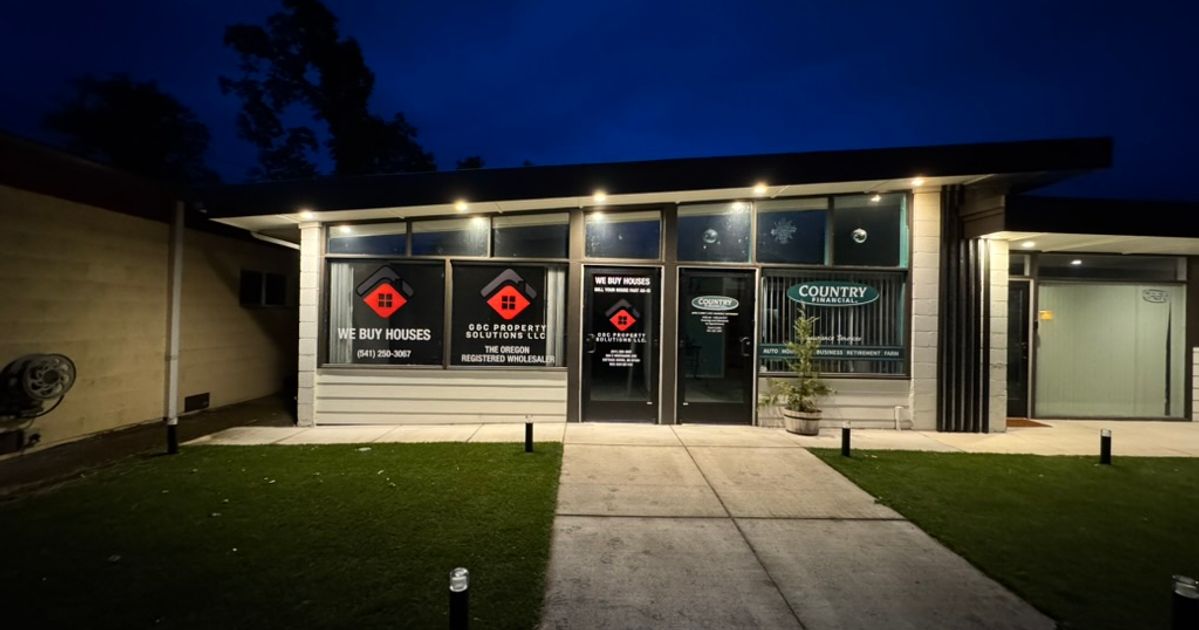
And we have something most cash buyers don't: a physical storefront you can walk into, at 508 E Whiteaker Avenue in Cottage Grove. Not a P.O. box, not a call center in another state. An office with our name on the door, in the town where our family lives. If you want to look someone in the eye before you sign paperwork on the largest asset you own, you can. Come see our office in Cottage Grove.
Castle Buys Houses is the consumer brand of G&C Property Solutions LLC. It's family-owned. Gerren built it from scratch, with four kids at home, in a business that has earned every bit of the skepticism people bring to it. The way we've decided to compete is by being the company that hands you the law and shows you how to check up on us.
We buy houses across Oregon — Portland, Eugene, Salem, Oregon, Medford, Roseburg, the I-5 corridor, Central Oregon, and the coast. Whatever your situation looks like, you can get a cash offer with no obligation, and you can take all three days.
If you're reading this after the fact — you signed with a cash buyer, something feels off, and you never got a disclosure — you have places to go.
File a complaint with the Oregon Real Estate Agency. Complaints go through the same eLicense system as the lookup, at orea.elicense.micropact.com, using the "Not licensed" option to create an account. You can also reach the Agency at (503) 378-4170 or orea.info@rea.oregon.gov, or write to 775 Summer St NE, Suite 330, Salem, OR 97301. The Agency reviews the complaint, notifies the other party and asks for their response, and assigns an investigator where warranted. More than 80% of cases close within 150 days. The Commissioner can also open an investigation without waiting for a complaint, and can go to court to stop someone from continuing.
Talk to a real estate attorney before your deadline passes, especially if you're inside the three-day window or you think no disclosure was ever provided. The attorney-fee provision in this law runs against the wholesaler, which changes the math on getting help.
One honest note, because a guide about transparency should be transparent about this too.
A cash offer from any wholesaler or investor, including us, will typically come in below what you'd get listing on the open market with an agent and waiting for a retail buyer. That's the trade. You're exchanging some price for speed, certainty, no repairs, no showings, no commissions, and no financing contingency that can collapse three weeks in.
For some sellers that trade is obviously worth it — a foreclosure sale date on the calendar, an inherited house four states away, a rental that's been destroyed, a divorce that needs to be finished. For other sellers it isn't, and the right answer is to list it. A cash buyer worth working with will tell you when listing is the better move. Here's how our process works, including what we look at when we build a number.
What HB 4058 changes isn't the price. It's whether you know who you're dealing with when you decide.
Is wholesaling real estate legal in Oregon? Yes. Wholesaling is legal in Oregon, but since July 1, 2025, House Bill 4058 requires most residential property wholesalers to register with the Oregon Real Estate Agency, pass a criminal background check, and provide written disclosure to sellers before entering into a contract. Wholesaling without registering is illegal and carries civil penalties and possible criminal charges.
What is HB 4058 in Oregon? HB 4058 is Oregon's residential property wholesaling law, passed in 2024 and effective for contracts entered on or after July 1, 2025. It creates a state registration requirement for wholesalers, mandates written disclosure to sellers and buyers before contracting, and gives sellers the right to cancel — including the right to cancel at any time and keep earnest money if the disclosure was never provided.
Do I have to be registered to wholesale a house in Oregon? Yes, unless you qualify for an exemption. Licensed brokers, principal brokers, and property managers are exempt if they give the proper disclosure, as are attorneys performing legal duties, fiduciaries such as receivers, conservators, bankruptcy trustees, personal representatives and trustees acting in that official capacity, and close family members acting under a recorded power of attorney. Everyone else must register, and a single transaction triggers the requirement. Registration is issued only to individuals, costs $300 initially and $300 annually, and expires each June 30.
Can I cancel a contract with a wholesaler in Oregon? Yes. Either party — seller or buyer — may cancel without penalty by delivering written notice before midnight at the end of the third business day after receiving the required disclosure. This right cannot be waived. And if the wholesaler never provided the disclosure at all, you may terminate at any time without penalty and retain any earnest money paid.
What if a wholesaler didn't give me the disclosure? Under HB 4058, you may terminate the contract at any time without penalty and retain any earnest money paid. To get deposits released from escrow you must give the escrow agent a written assertion that no disclosure was provided along with a demand for the funds, plus a written release and indemnification protecting the escrow agent. The wholesaler may be liable for damages, and a prevailing party recovers reasonable attorney fees and costs from the wholesaler. Talk to a real estate attorney about your specific situation.
How do I check if an Oregon cash home buyer is registered? Use the Oregon Real Estate Agency's eLicense lookup at orea.elicense.micropact.com. Select "Wholesaler" from the License Type dropdown and search the individual's last name — Oregon issues this registration only to people, not companies, so if you were given a company name, ask who the registered individual is. Confirm the record is active and matches the person signing your contract. If they claim a broker exemption, search under Broker, Principal Broker, or Property Manager.
What is the penalty for wholesaling without a license in Oregon? A knowing violation is a Class A misdemeanor. Civil penalties run $1,000–$2,500 for a first offense and $2,500–$5,000 for subsequent offenses, plus an additional penalty up to the full profit made on the transaction. Unregistered wholesalers also cannot bring a lawsuit to enforce any claim arising from their wholesaling activity.
What has to be in an Oregon wholesaler disclosure? In at least 10-point bold type, it must state that the person is acting as a wholesaler, that they hold only an equitable interest, that they lack legal title and might be unable to transfer title directly, and that they might not be a licensed broker or appraiser. State rules also require the form to explain your three-business-day cancellation right, define equitable interest, state that a wholesaler may assign that interest for a profit before closing, and tell you how to file a complaint. Use the official form published on the Oregon Real Estate Agency's website.
What does a wholesaler have to do to get registered in Oregon? They must be an individual at least 18 years old with a high school diploma or GED, list all business entities and assumed business names with the Oregon Secretary of State, get fingerprinted in person at a Fieldprint location, pass a criminal records check through the Oregon State Police and FBI, and disclose every felony, misdemeanor, arrest, DUI, administrative proceeding, adverse judgment, and bankruptcy. The Agency then determines whether the applicant is fit to hold the registration. The fee is $300 to apply and $300 a year to renew.
Why should I sell to a registered wholesaler instead of any cash buyer? Because the state has already vetted them and you can verify it yourself in about 90 seconds. Registration means fingerprints, an FBI and Oregon State Police records check, mandatory disclosure of judgments and bankruptcies, and a state determination that the person is fit to hold it. A registered wholesaler also risks losing that registration if they mistreat you, and can be disciplined by the Real Estate Commissioner. An unregistered operator has none of that on the line — and cannot bring a lawsuit to enforce a claim arising from their wholesaling activity.
Does HB 4058 apply to commercial property? No. HB 4058 applies to residential property — land zoned residential and existing condominium units as defined in ORS 100.005. Mixed-use property can fall into a gray area, which is worth asking an attorney about if that's your situation.
Is Castle Buys Houses a registered wholesaler? Gerren Castle is a registered Oregon residential property wholesaler, OREA registration number {{OREA_REG_NUMBER}}, and G&C Property Solutions LLC — doing business as Castle Buys Houses — wholesales through him. Oregon issues this registration only to individuals, never to companies, so that structure is what compliance actually looks like. Our office is at 508 E Whiteaker Avenue in Cottage Grove. Verify the registration yourself in the Oregon Real Estate Agency's lookup by selecting "Wholesaler" and searching Castle. We provide the state's written disclosure to every seller before anything is signed.
